Illustrator


The Creek - Archaeological Reconstruction

Beneath the modern city of Almere (Netherlands, Flevoland) lies a drowned world that once looked very different. Thousands of years ago, this region was alive with shifting sands, rising waters, and our ancestors who gathered food, knapped flint, and lit their fires amidst that constantly changing landscape.
In 2010, a large-scale archaeological investigation was carried out in Almere Haven, in the area known as De Laren. This research uncovered traces of campsites, flint tools, pottery, and soil layers that revealed a long and complex history—from the end of the last Ice Age through the Mesolithic, Neolithic, and even into the Iron Age. The municipality of Almere commissioned me to reconstruct this world, focusing on the people who lived here between 8800 and 5300 BC, before the land was swallowed by water between 4775 and 4020 BC at the beginning of the Neolithic.
Reconstructing the Past
For me, illustrating this environment was about more than landscapes and artifacts—it was about reconnecting with the people who once thrived here. I set out to visualize daily life: a woman gathering hazelnuts and herbs, a man spearfishing, an elder just done with knapping flint and busy with processing fish by the fire (ponassing), and another elder preparing a tasty salad with leaves, berries, and herbs. In short, a family gathering by the fire as day turns into night. Set against sandy ridges, heath, forests and a creek, this family scene embodies resilience and adaptation in an ever-shifting landscape.
The reconstruction was based on extensive archaeological data—drillings, stratigraphy, pollen analysis, and artifact studies. I translated these findings into a visual interpretation to make the story accessible to a wider audience. Today, the illustration is displayed on a large board at the excavation site De Beek (The Creek), now a playground and gathering place for the community. The panel connects residents to their local past by linking key features of the artwork to specific research findings.


The Archaeological Findings
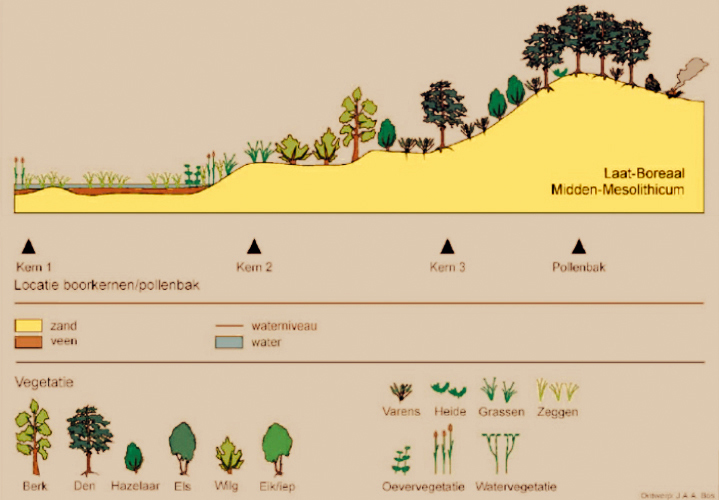
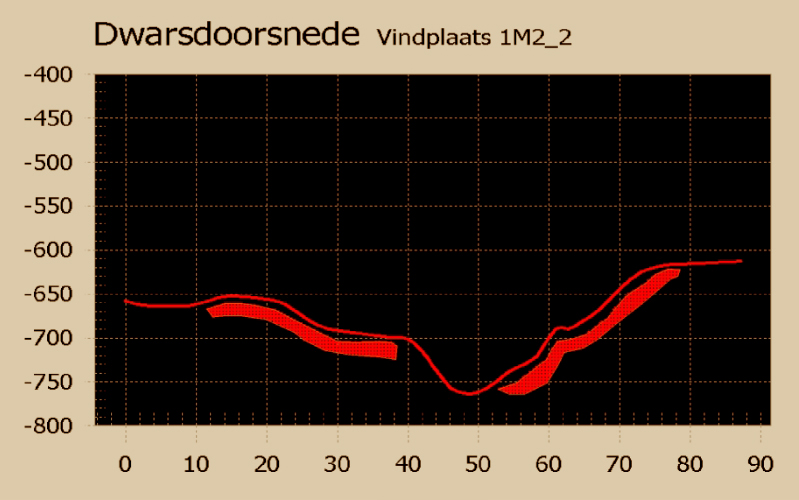
Archaeologists mapped the ancient environment by systematically collecting borehole samples across the area. The layers revealed rolling sand dunes formed during the Ice Age, river deposits, podzol soils, and peat that developed as the water table rose. Each step in this sequence showed how the land transitioned from dry ridges and open woodland into wetlands and swamps.
Evidence of human presence was found on the sand ridges. Flint tools and charcoal mark campsites from both the Mesolithic and Neolithic periods. More surprisingly, Iron Age pottery was also uncovered—rare in this region—which suggests temporary settlements along the wetlands at that time. These finds provide missing pieces in the archaeological record of Flevoland.
Vegetation and Environment
Soil and pollen analyses revealed how vegetation shifted with the changing climate. A climate cooling and warming, forests spreading and retreating and shifting waters that shaped where people could live.
- On higher sandy ridges: light forests of pine, birch, and hazel thrived, with heather and grasses in open clearings.
- In valleys with richer soils: elm, oak, and linden took root, while mistletoe grew in the canopy above ferns and moss.
- Around rising streams and valleys: bulrush, bur-reed, and eventually alder swamp forests developed as water levels increased.
These shifting conditions forced communities to adapt where they could camp and forage.

The iconic Pesse canoe, dating to about 8040–7510 BC and carved from Scots pine near Drenthe (close to Flevoland's prehistoric river systems), revolutionized mobility in these wetlands. Enabling efficient travel across marshes and creeks and for spearfishing or hunting bows from the canoe itself. This dugout canoe, now in the Drents Museum, underscores the ingenuity in exploiting the Rhine, Maas, and Waal river basins.
Key Excavation Areas
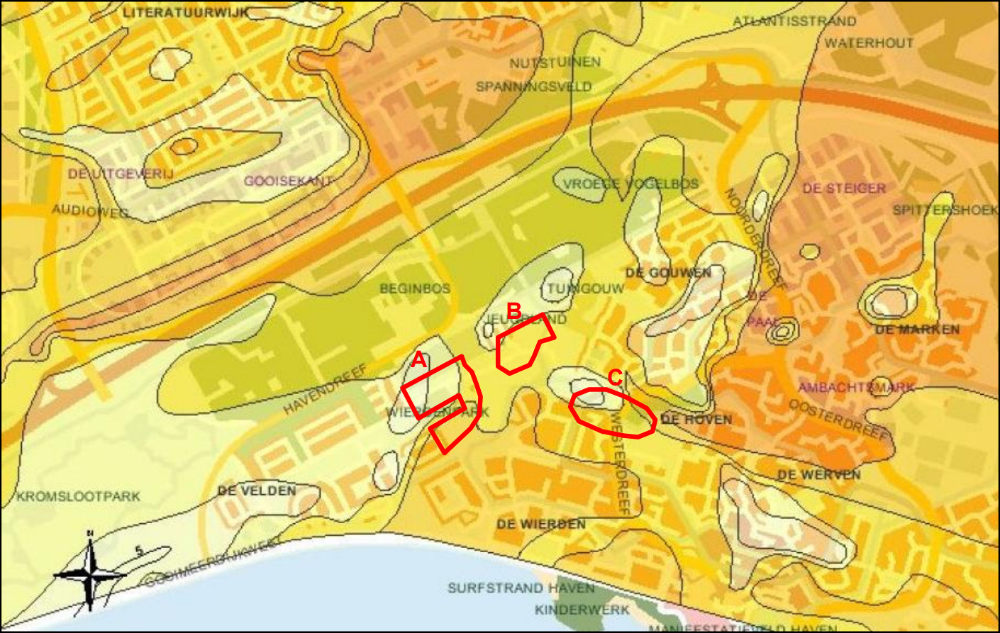
- Area A: One site on the slope of a sand ridge. They found a small flint flake and scattered charcoal—subtle traces of a single tool-making event or fire.
- Area B: Two sites were found. One a partly eroded sand ridge site, and one in a small valley. The findings: Multiple worked flints, and some burnt flint (activity near fire), plus charcoal. Although small, these finds revealed repeated activity occurred there thousands of years ago. The drillings suggest a creek ran through it. It must have been a small river valley, with little groups establishing camps near the water sources. This became the focus of my illustration.
- Area C: The richest of the three, with four Mesolithic/Neolithic camp sites on sand ridges with evidence of reuse across generations. Finds included flint, hearth clusters and animal bones, both burnt and unburnt, hinted at meals eaten or rituals performed around fires. Three possible Iron Age sites were found containing pottery, bone, and charcoal, dating to approximately 750–12 BC.
An Ever-Changing Landscape
The deeper layers reveal glimpses of life stretching back to the very end of the last Ice Age. At that time, this was a land of contrast. As the ice sheets melted, the sea level rose and the groundwater crept steadily higher. The valleys between the sand ridges became wetter. What had once been light, dry woodland slowly transformed into alder swamp forests. Along the water’s edge, bulrush, bur-reed, and other wetland plants spread, already turning parts into marshy terrain. High dunes of dry, windswept sand still rose above the low wetlands. Mesolithic hunter-gatherer groups roasted hazelnuts, caught fish, and left red ochre and flint tools behind. The artifacts also connect to the Swifterbant culture, which are later inhabitants of the area.
As the Holocene climate warmed, sea levels rose, groundwater swelled, and wetlands expanded across the land. Communities continually adapted—moving camps, gathering food in forests, fishing in creeks, and finding new safe grounds as familiar ridges were swallowed by peat and marsh. By the Late Neolithic and Early Bronze Age, families lived along peat-rich riverbanks that carried both opportunities and challenges. On top of the peat are aquatic clay and sandy clay deposits from the Flevomeer, Aelmere, and Zuiderzee. These deposits mark different phases.
These layers beneath Almere tell a story of endurance, adaptation, and coexistence with a changing natural world.

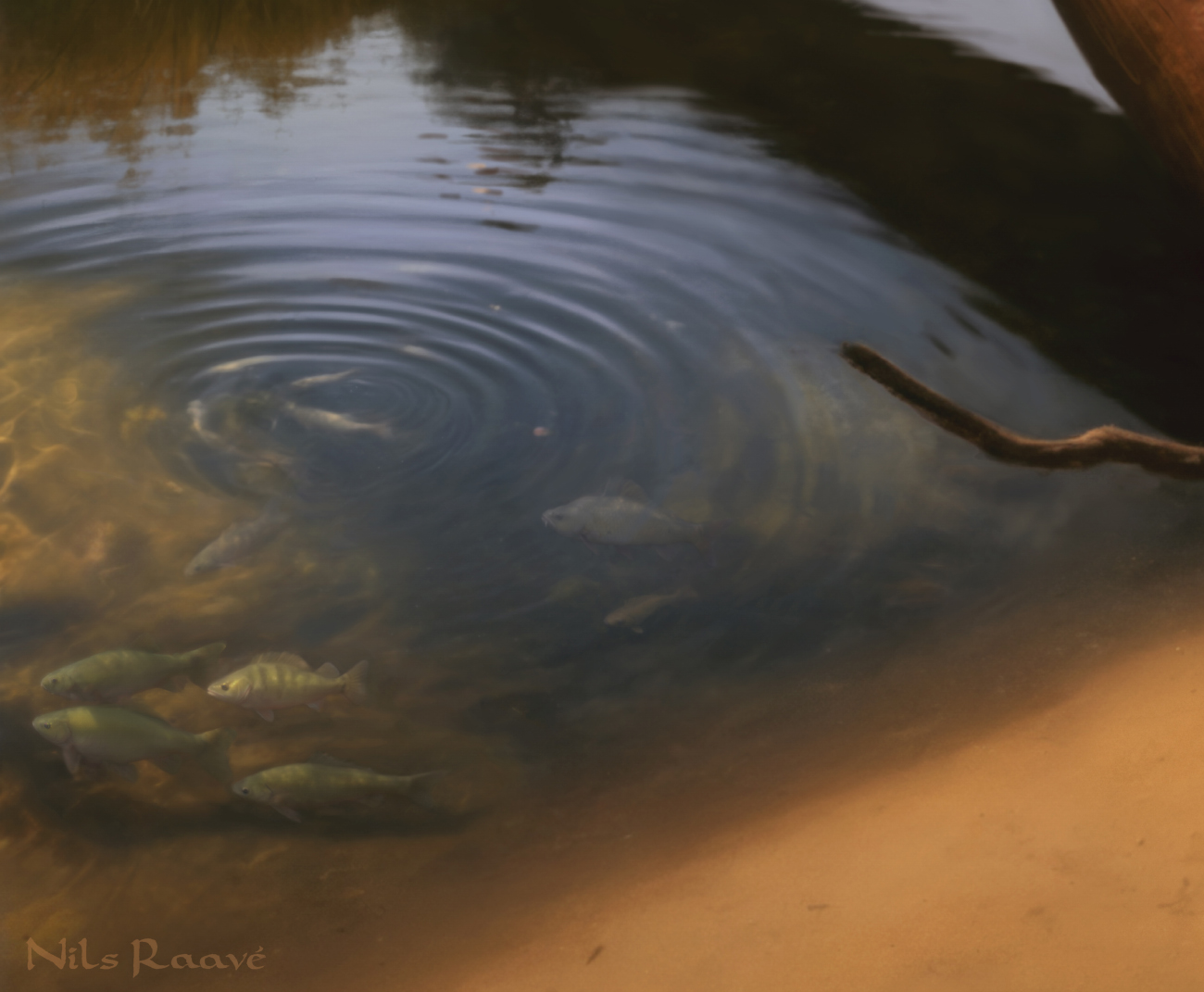
The people there mastered fishing with leisters (multi-pronged spears), nets, and hooks made from bone or antler, targeting species like tench, perch, carp, bream, eel, pike, flounder and sturgeon. Hunting techniques focused on waterfowl and mammals using bows, arrows with microlith barbs, and traps.
The Holmegaard bow, named after peat bogs in Denmark's Zealand island, represents the pinnacle of archery tech from this era, dating to around 7000 BC (roughly 9000 years ago). These bows measured 170–180 cm long with wide, parallel limbs tapering to points, a deep cutaway handle, and a D-shaped cross-section for power and symmetry. Found preserved in oxygen scarce bogs, they were used by groups across northern Europe, including Dutch territories, to propel light arrows tipped with flint or blunt heads for birds and small game—capable of speeds up to 178.64 km/h (111 mph) in replicas.
The migratory garganey duck, was a prime target for these hunters. Fossil remains from Mesolithic sites show it alongside other fowl like the mallard duck. They were hunted seasonally during breeding migrations from Africa to Europe.
Art director and client:
- Drs. Wouter Smith. Archeologist and Policy advisor for archaeology at the municipality of Almere. He worked on the initial excavation in 2010/2011.
- Helle Molthof, BA, MA. Archeologist and Policy advisor for archaeology at the municipality of Almere.
Credits:
- The landscape elements, sediment and height chart come from the research and source materials that Wouter Smith and Helle Molthof supplied me with.