Illustrator


The Makers of Holland - Museum illustrations


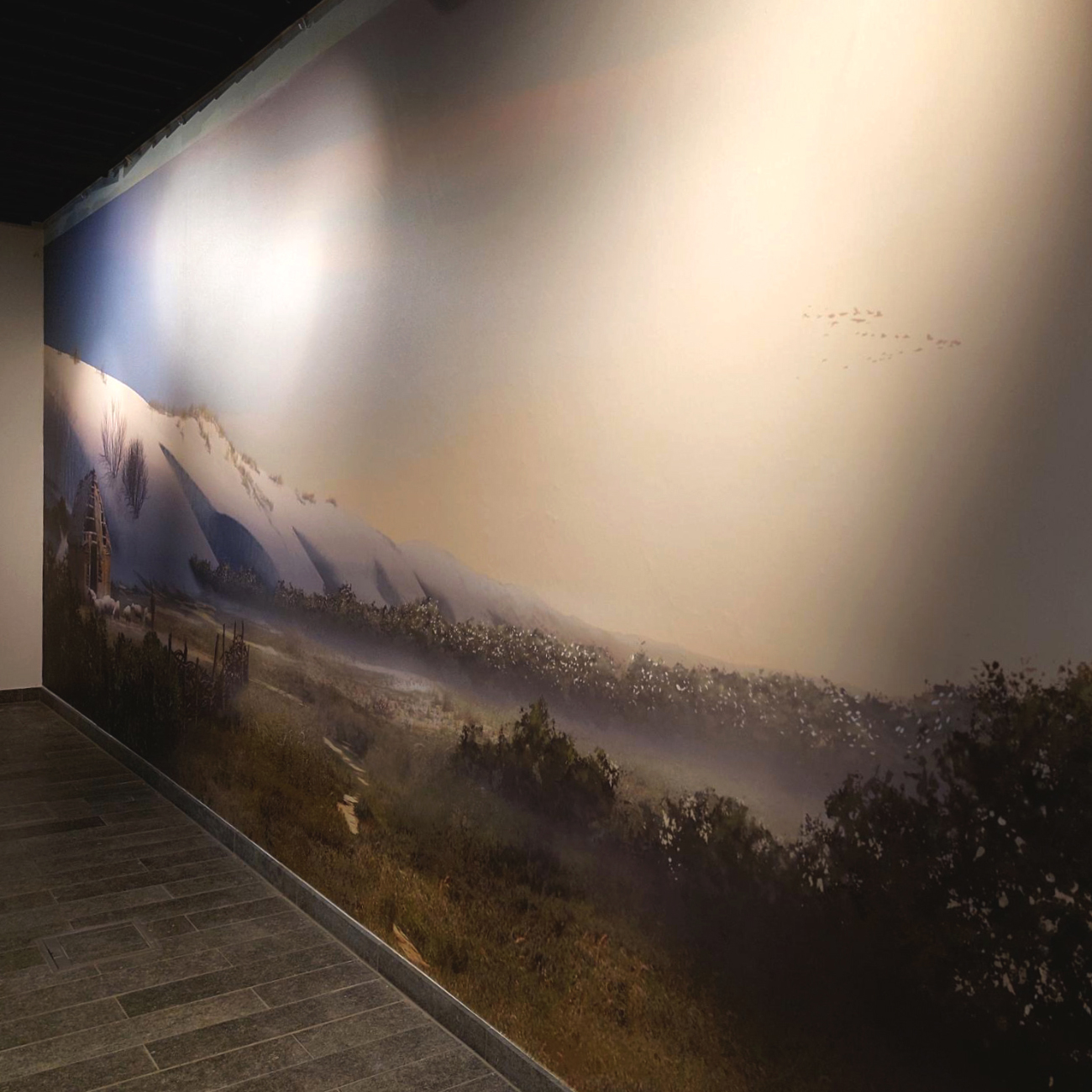
Who were the pioneers that shaped the landscape of Holland? These are four large illustrations I created for the travelling exhibition called "De Makers van Holland" (The Makers of Holland) that was presented at multiple musea in the provinces of Holland. They depict Dutch manmade landscapes (except for the advancing dunes) as they are formed from 900 to 1300 AD. There is almost nothing left of the landscapes from the time before that. These landscapes are unique and appear almost only in Holland. They are still recognisable in the provinces of South and North Holland of today.
Around the year 900 the area what is now the provinces of South and North Holland was at that time a remote corner of the First German Reich. This empire did not yet count for much, and the coastal area along the North Sea was even less significant. Maybe some 6000 people lived between Monster and Texel, mainly in the dune area and along the mouths of the rivers Maas and Rhine. The rest of the land was mainly made up of inaccessible marshes. From that time onwards, the land was rapidly reshaped. Sand drifts drove the inhabitants of the coastal region from their fields and yards. But hundreds of others intentionally moved into the marshes to convert them into farmland.
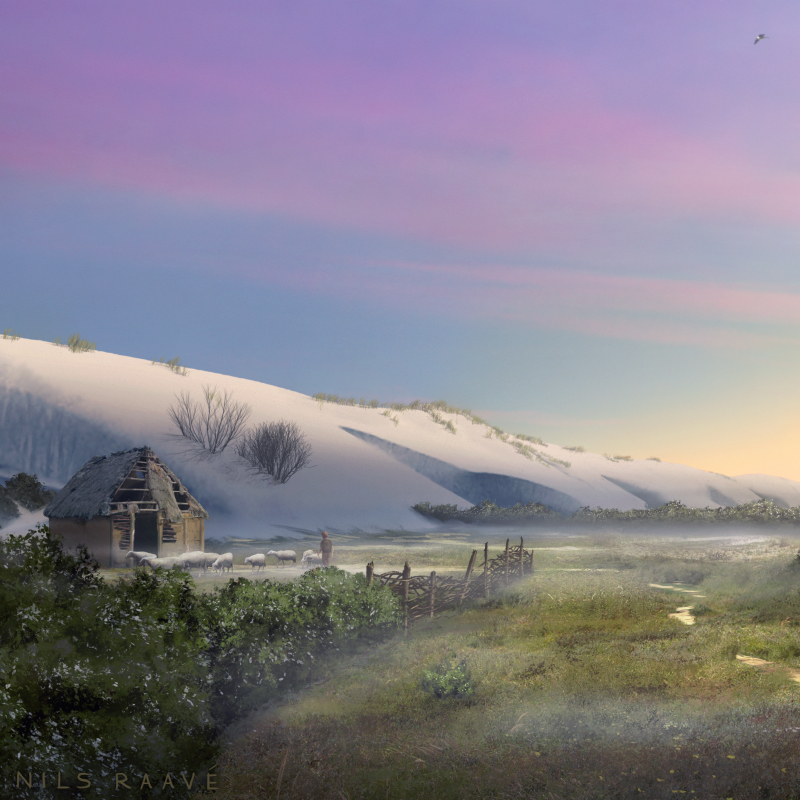
Advancing dunes. Spring 950 AD
The dunes as we know them now have been shaped by the wind between 900 and 1500 AD. They have covered the "old" dune landscape that formed in prehistory and they also covered the settlements and fields of the people who lived there, because they did not yet know how to stabilize, keep in place and protect the dunes from further erosion and spreading. Eventually people learned how to do this with beach grass (marram grass) and some other methods. This reconstruction is based on the excavations on the Waalsdorpervlakte (an open place in the dune area "Meijendel) near The Hague and Wassenaar.
Drained swamp. Summer 1150 AD
Another prehistoric landscape that got lost in the middle ages, but now by the hand of man. The thick layers of fen behind the coast. They were drained by little canals and converted to arable land that later became pastureland. This reconstruction seen from the still extensive moorland is based, among others, on the excavations at Portland and Barendrecht.

Dike alongside the Maas river. Winter 1275 AD
As land was reclaimed, the land lowered increasingly. It became prey to the rivers and lakes as they were pushed onward by storms. To protect their land and themselves the farmers worked together to build long and sturdy dikes and sluices. They utilized floodplains to improve water management. This reconstruction draws on excavations in and around Rotterdam.
This illustration was also used in the mini exposition of "Zuid-Hollanders en het water in het verleden en nu" (South Dutchmen and water in the past and present). Part of the "Canon van Nederland" (Canon of Holland).


Emerging Towns and Fortifications. Autumn 1300 AD
Around 1300 AD more than 20 villages in Holland got city rights. In our eyes these were still villages with at the most a few thousand inhabitants. But these were already important centres of civil power. The count and the nobles showed their military power by means of their castles. The illustration shows a landscape near Alkmaar, an area where a battle had taken place a few years earlier. I based the reconstruction of this illustration on the research into the castle locations in the vicinity of Alkmaar.

The exhibition was made financially possible by the province of South Holland with support from the province of North Holland.
- Art Director: Evert van Ginkel from cultural historical public relations agency TGV teksten & presentatie
- The first exhibition was located at Stadswinkel Dordrecht.
- The second exhibition was located at Huis van Hilde in Castricum.



My illustrations featured in Archeologie Magazine, the magazine on archaeology in The Netherlands.